
Background on the Reading Wars
The “reading wars” was a term used to mean the ongoing debate about how to teach reading. Educators, parents, and policymakers wrangled about what might be the best approach.
For almost 100 years, we have been tinkering with teaching reading. In the 19th century, reading was taught by “the alphabetic” method. Students learned letter names and then the specific sounds associated with those letters. Besides teaching students to read, the method taught them to spell. Young students progressed through grades using the McGuffey Readers.
The Reading Wars Begin
It’s difficult to say exactly when the first shot was fired. However, by the early 20th century, methods were in flux. Prominent education reformers like Horace Mann criticized the methods. They argued that it was tedious and boring for young children.
Around 1925, a new method was emerging. It was called “look-say.” By mid-century, it was firmly ensconced. Students learned to read by learning words that were accompanied by pictures. The words were simple, the pictures were simple, and the stories were simple. Yet many children struggled with reading.
America Meets Rudolf Flesch
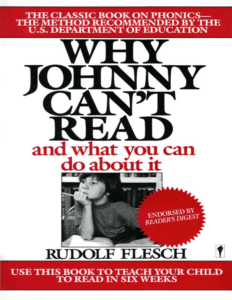

Rudolf Flesch was an Austrian-born Jew who fled the Nazi annexation in 1938. He enrolled at Columbia University’s Teacher College and became fascinated with the English language. He received a Ph.D. in English and research psychology in 1943.
Soon after, he developed mathematical formulas to indicate the reading difficulty in any piece of writing. His Flesch Reading Ease Score was published in 1948. It is still used to calculate a “reading ease” score based on sentence length and the number of syllables per word.
Later, working with J. Peter Kincaid, this formula was modified for the U.S. Navy to create the Flesch-Kincaid Grade Level formula.
The Reading Wars Escalate
By the 1950s, Flesch was focusing on reading instruction. He had offered to tutor a neighborhood boy named Johnny who was struggling to read. He was shocked to find out that the schools had abandoned phonics in favor of look-say. This led him to write his book, Why Johnny Can’t Read: And What You Can Do About It.
The book was published in 1955 and spent 37 weeks on the bestseller list. He was famously quoted as saying,
“Do you know that the teaching of reading never was a problem anywhere in the world until the United States switched to the present method around about 1925?”
He called the look-say method a “complete failure” and accused the educational establishment of committing a crime against a generation of children. He published his follow-up, Why Johnny Still Can’t Read, in 1981. Two years later, A Nation at Risk was published, further detailing the crisis in American literacy.
The National Reading Panel Report
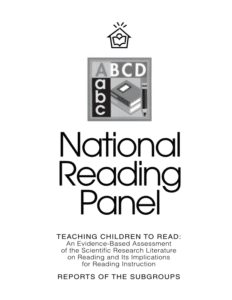
In 1997, the National Institute of Child Health and Human Development was tasked to put together a panel of reading experts. Their mission was to review decades of scientific research and determine, once and for all, which reading instruction methods really work.
The report was published in April, 2000. It also laid the foundation for what is now called the “science of reading.” The report largely validated Rudolf Flesch’s core argument–that skipping systematic, explicit phonics instruction is non-negotiable for teaching children (or anyone) how to read effectively.
Is the Reading War Over?
It would be comforting to conclude that the reading wars are over. Sadly, that isn’t the case.
While the NRP report should have ended the controversy, the failed methods continue. Rudolf Flesch won the battle, but America’s families are still losing the war.
However, there is good news: A number of states have enacted laws requiring the systemic, explicit teaching of phonics. Mississippi, in particular, has made dramatic progress that’s become know as the “Mississippi miracle.” Still, you’ll find disparate accounts about this success. It appears that the education insiders would rather teach words than reading.
Therefore, the battle must continue.
