Despite all attempts to narrow achievement levels in educational achievement, nothing seems to change. It makes me ask: who’s minding the education gap? Furthermore, what’s really the problem?
The government and the education industry have diligently focused on the problem since at least 1965 when the ESEA (Elementary and Secondary Education Act) was passed. Lawmakers have modified and reauthorized this law for the past 50 years. We’ve all heard of No Child Left Behind, passed in 2001. You may not be aware that ESEA was modified and reauthorized again in 2015 by the Obama administration as the Every Student Succeeds Act (ESSA).
Each new incarnation of these laws adds special requirements for the education of low-income students, special education students, and English language learners. In fact, the ESSA has now added additional benefits aimed at gifted students as well.
Minding the Achievement Gap at Home
With all this energy and updating, you would assume that our students are much more successful now than they were in 1965. Unfortunately, you’d be wrong. Our own intranational measuring system, the National Assessment of Educational Progress (NAEP), shows very little improvement.
Look at the chart published by NationsReportCard.gov. From 1992 to 2017, only five points have been added to the national average reading score for fourth graders. With a high of 500 points, our fourth graders have “progressed” from 217 points in 1992 to 222 points in 2017. Sadly, this doesn’t tell the whole story.
An even more discouraging chartfrom NAEP shows the percentage of students who have attained reading proficiency in grade 4. According to NAEP, proficiency means that “a student has demonstrated competency over challenging subject matter.” This bland description belies the fact that only 36% of our fourth graders were proficient in reading for the last NAEP test.
The remaining 64% were at the “basic” level. NAEP’s definition of “basic” puts the issue in greater perspective. A student at the basic level has only partial mastery of the knowledge and skills that are fundamental for proficient work at a given grade level. Worse yet, a student who is not a proficient reader by grade 4 will not be likely to improve. The reading scores for grades 8 and 12 bear this out.
Minding the Gap with the World
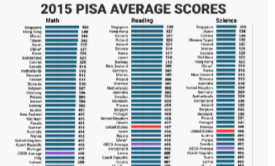
Every three years, the Organization for Economic Co-operation and Development (OECD) administers a worldwide exam to 15-year-olds in 72 countries. The is called the Program for International Student Assessment (PISA). The students take standardized tests in reading, math, and science. The most recent PISA data is from the 2015 test.
In reading, the U.S. ranked 24th in reading, just four points above the international average. The results were worse in math and science.
What Should We Do?
We can begin by recognizing that we have a problem. Otherwise, we can’t continue to enjoy the benefits of success and leadership when our students are getting more and more mediocre. Of course, this situation is bad for them, but it’s worse for us as a whole.
It’s clear that continuing to tinker with legislation, even with inspiring names, and spending more and more money is not the answer. We need to reset our thinking about the importance of education to our children and our country. Increase parental involvement and raise expectations. Children should understand that nothing is more important during the school day than succeeding in school. Not fun, not friends, not phones.
Teaching students to read with less effort will help them go on in math or science, with an arsenal of tools for soaking up knowledge. That’s our focus at SoundEnglish.
Contains information related to marketing campaigns of the user. These are shared with Google AdWords / Google Ads when the Google Ads and Google Analytics accounts are linked together.
90 days
__utma
ID used to identify users and sessions
2 years after last activity
__utmt
Used to monitor number of Google Analytics server requests
10 minutes
__utmb
Used to distinguish new sessions and visits. This cookie is set when the GA.js javascript library is loaded and there is no existing __utmb cookie. The cookie is updated every time data is sent to the Google Analytics server.
30 minutes after last activity
__utmc
Used only with old Urchin versions of Google Analytics and not with GA.js. Was used to distinguish between new sessions and visits at the end of a session.
End of session (browser)
__utmz
Contains information about the traffic source or campaign that directed user to the website. The cookie is set when the GA.js javascript is loaded and updated when data is sent to the Google Anaytics server
6 months after last activity
__utmv
Contains custom information set by the web developer via the _setCustomVar method in Google Analytics. This cookie is updated every time new data is sent to the Google Analytics server.
2 years after last activity
__utmx
Used to determine whether a user is included in an A / B or Multivariate test.
18 months
_ga
ID used to identify users
2 years
_gali
Used by Google Analytics to determine which links on a page are being clicked
30 seconds
_ga_
ID used to identify users
2 years
_gid
ID used to identify users for 24 hours after last activity
24 hours
_gat
Used to monitor number of Google Analytics server requests when using Google Tag Manager