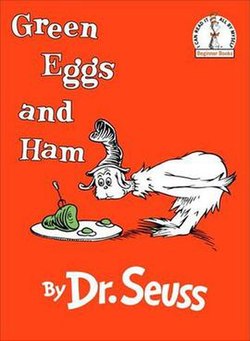
Theodor Geisel, better know as Dr. Seuss, wrote his first children’s book in 1937. It was And to Think I Saw It on Mulberry Street. It would be 23 years before he would write Green Eggs and Ham, and it probably would never have happened without “the bet.”
Long before the publication of Green Eggs and Ham, Geisel had achieved the essence of his style in children’s books. He perfected the use of silly stories, unusual visuals, rhyming verses, and, most of all, limited vocabulary. Before 1960, his most popular book was The Cat in the Hat. It included only 236 words and was a tremendous success. Then came “the bet.”
What was the bet on Green Eggs and Ham?
After the success of The Cat in the Hat, Seuss was challenged by his publisher. The publisher wanted a book using no more than 50 distinct words. As an incentive, he bet Giesel $50 that he couldn’t do it. In today’s terms, that doesn’t seem much of an incentive. However, in 1960, it was the equivalent of $550 today.
The result was Green Eggs and Ham. It’s the story of two characters, one of which is Sam-I-Am, and the other has no name. Sam is determined to convince Character Two that he should try green eggs and ham, and he won’t take no for an answer. For 53 of the book’s 62 pages, Sam insists that Character Two would like green eggs and him if he would only try it. His suggestions are more and more outlandish, and Character Two is unmoved. Nevertheless, Sam’s persistence is steady, and his enthusiasm is unflagging. Finally, on page 54, Character Two relents. Of course, the reader is amazed when Character Two discovers that he loves green eggs and ham!
Isn’t it just a silly story?
Green Eggs and Ham is much more than a silly story. It’s a work of art in children’s literature, and it’s a model for early success in reading instruction. Here’s why:
First, the content: it’s an interesting story–a fantastic representation of characters in conflict. It seems a silly conflict, no doubt, but it is a conflict nonetheless.
Second, the structure: much of the book is written in anapestic tetrameter. Perhaps you don’t remember your high school poetry. No problem! Anapestic tetrameter is four groups (tetrameter) of three syllables in which only the third syllable is stressed. Think of it as “da da DUM.” It gives the story a “sing-song” quality that children enjoy, and Seuss was known for it.
Third, the educational impact: using only 50 distinct words to tell a story of 778 words means constant repetition. How quickly within that story will the average child begin to recognize those words and understand that they are actually reading! The difficulty level of the book, based on the Flesch-Kincaid Grade Level scale is .5 to 1.5. That means that even a preschooler might find himself “reading” by the second half of the book.
What Important About the 50 Words Used in Green Eggs and Ham?
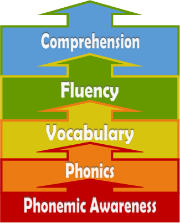
The first step in learning to read is phonemic awareness. It’s the first of the five foundational skills required for reading success. It’s true that Green Eggs and Ham doesn’t specifically teach phonemic awareness, as we do in Step 2 of our structured program, 7 Sound Steps to Reading. However, most young children will get the sense of it as words are repeatedly associated with specific sounds.
Sight Words in Green Eggs and Ham
When learning to read, there are only two “classes” of words: those that are phonetic and those that are not, which are call “sight words.” Frankly, the distinction is not well understood. In phonetic words, letters produce predictable sounds based on the 44 sounds of English and can be decoded. Sight words have letters that, for one reason or another, behave unpredictably. Thus, “sight words” must be learned so they can be recognized on sight. Yes, memorized.
Fortunately, about 85% of all English words are phonetic, and many of the remaining sight words are common, high-frequency words that students pick up quickly. Of the 50 words in Green Eggs and Ham, 40 are phonetic. (That’s 80% if you do the math.) Any young reader who had completed the first two steps of our seven-step program would be able to read those words independently.
Likewise, the sight words are a, are, could, do, the, there, and was. As you can see, they are common, high-frequency words. All of them are learned during Step 2.
What’s the Take-Away?
The book offers a lot to recommend it. First, it’s a masterclass in minimalist storytelling. With Seuss’ usual creativity in illustrations and rhyming verse, it’s the perfect classic children’s book. Given that it’s one of the top ten bestselling books of all time is testament enough. In fact, in the first quarter of 2026, it was still the number one seller in juvenile fiction.
However, it’s so much more. It’s perfect for beginning readers. Green Eggs and Ham uses rhythmic repetition and simple vocabulary to build reading confidence. With a grade level appropriate for preschoolers, it’s the gold standard for transitioning a child to independent reading.
If you want to teach your child to read or help a poor reader improve, you can bet on Green Eggs and Ham.