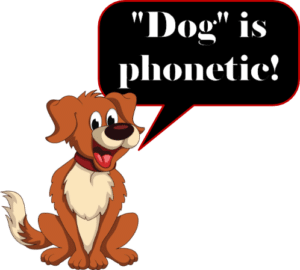
I’ve experts who minimize the importance of phonics in reading instruction. Usually, they think our language is just too complex to be reduced in this way. So often, it seems they don’t understand when a word is phonetic and when it isn’t and why it matters. Naturally, they can’t come to a rational conclusion about why phonics might be important.
It’s easy to be confused about what is phonetic and what isn’t. However, once you have a clear understanding of just how phonics works, it’s all fairly. Once you get that far, it’s pretty obvious why it matters.
First, Let’s Define Phonetic
The word is derived from the Greek root “phone,” which means sound or voice. That root appears in hundreds of English words, all of them related to production of sound. To name just a few, think about telephone, microphone, symphony, and phonetic.
Both “phonetic” and “phonetics” relate to producing speech sounds. “Phonetics” is the study of the production of speech sounds. “Phonetic,” on the other hand is a label confirming that a letter represents a specific, predictable speech sound based on the recognized 44 sounds of English. You can find the list here.
Are There Degrees of Phonetic?
The best answer is no. Remember that “phonetic” applies to the letters within a word as well as the word itself. Words are either phonetic in total, or they are not. A word is only judged to be phonetic if all of its letter are also phonetic. If even a single letter is not phonetic, the word is not phonetic.
Nevertheless, it’s helpful for learning to see the concept of phonetic as a continuum rather than an absolute. This is how we approach it in 7 Sound Steps to Reading. We agree that, to be phonetic, all the letters in a word must predictably produce their expected sound. An S must make the sound in “snake;” an SH must make the sound in “shell,” and so on. On the other hand, when S makes the sound associated with Z, as it does in the word “is,” it is not phonetic.
For the first half of our phonics lessons, any word that is not strictly phonetic is introduced as a sight word. Our first two sight words in Step 2.1 are “the” and “is.” A new reader cannot decode a word that is not phonetic. “Is” enjoys the predictable sound of short I, but “the” is completely nonphonetic.
However, since learning happens more like turning up the dimmer on a light rather than flipping a switch, we do work with the concept that there are “degrees of phonetic” in words, beginning in the second half of Step 2.
Bonus Words Are Quasi-Phonetic
In English, 15 to 16 percent of our words are nonphonetic, which classifies them as sight words. However, many of the words in this classification could be decodable. A student would need to know the “special” letters combinations that appear in a limited number of words. For example, when WR occurs at the beginning of a word, the W is silent. This occurs in fewer than 35 words. Nonetheless, a student who knows about this combination will be able to decode common words like write, wreck, wrong, wrist, and more.
As a result, we coined a term for these types of words. We call them “bonus” words, and we introduce them in groups to show new readers the pattern. Bonus words are not phonetic, but they are decodable, which is as good as being phonetic, if the student knows the bonus letter pattern.
Why Does It Matter?
It matters because learning to read becomes easier when the process begins with phonics and proceeds with as much consistency as possible. It’s easier to expand a novice reader’s experience after the foundation has been laid. At the end of Step 2.6, halfway through the phonics program, we’ve covered A to Z, but it has only included the sounds of the consonants and the short vowels. All the reading has been controlled vocabulary, and there have been only 17 sight words in the first six parts of Step 2.
Once this foundation is established, it’s much easier to expand a student’s reading vocabulary. You can use a book like Frog on a Log to enhance confidence and the sense of actually reading. While bonus words don’t teach a universal phonics principles, they offer more learning potential than individual sight words. That’s why they are called “bonus!”
Contains information related to marketing campaigns of the user. These are shared with Google AdWords / Google Ads when the Google Ads and Google Analytics accounts are linked together.
90 days
__utma
ID used to identify users and sessions
2 years after last activity
__utmt
Used to monitor number of Google Analytics server requests
10 minutes
__utmb
Used to distinguish new sessions and visits. This cookie is set when the GA.js javascript library is loaded and there is no existing __utmb cookie. The cookie is updated every time data is sent to the Google Analytics server.
30 minutes after last activity
__utmc
Used only with old Urchin versions of Google Analytics and not with GA.js. Was used to distinguish between new sessions and visits at the end of a session.
End of session (browser)
__utmz
Contains information about the traffic source or campaign that directed user to the website. The cookie is set when the GA.js javascript is loaded and updated when data is sent to the Google Anaytics server
6 months after last activity
__utmv
Contains custom information set by the web developer via the _setCustomVar method in Google Analytics. This cookie is updated every time new data is sent to the Google Analytics server.
2 years after last activity
__utmx
Used to determine whether a user is included in an A / B or Multivariate test.
18 months
_ga
ID used to identify users
2 years
_gali
Used by Google Analytics to determine which links on a page are being clicked
30 seconds
_ga_
ID used to identify users
2 years
_gid
ID used to identify users for 24 hours after last activity
24 hours
_gat
Used to monitor number of Google Analytics server requests when using Google Tag Manager